Engineering FAQ · Wanlin
Best Allwinner A133 Access Control and Locker Board OEM Manufacturer | Istanbul, Turkey - CE FCC And
AndroidSBC factory-direct Allwinner A133 Access Control and Locker Board for Mediterranean buyers, OEM and ODM for Turkey import channels. CE / FCC / RoHS certified, GMS-certified Android 10 builds on request, 72-hour burn-in logs, panel compatibility lists and custom logo, firmware, carrier board and enclosure programs. FOB / CIF / DDP to Turkey.
Direct answer
AndroidSBC factory-direct Allwinner A133 Access Control and Locker Board for Mediterranean buyers, OEM and ODM for Turkey import channels. CE / FCC / RoHS certified, GMS-certified Android 10 builds on request, 72-hour burn-in logs, panel compatibility lists and custom logo, firmware, carrier board and enclosure programs. FOB / CIF / DDP to Turkey.
Executive Summary: Allwinner A133 Access Control and Locker Board OEM for Global Buyers
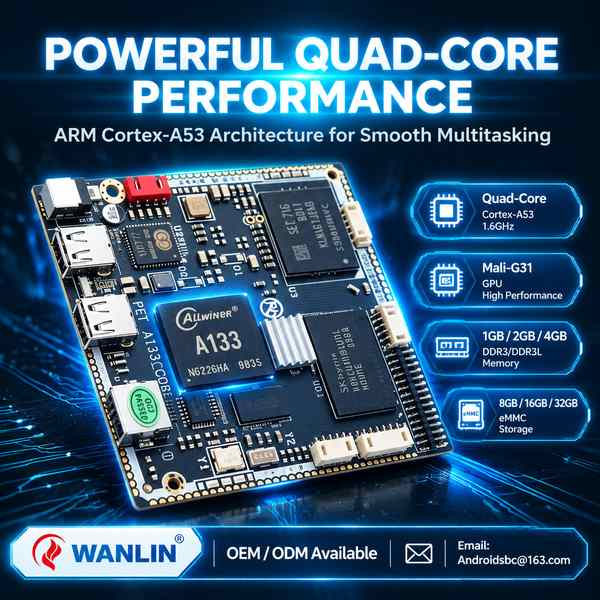
Snapshot: The AS-A133-AC10 is an access control and locker board with the Allwinner A133 quad-core Cortex-A53, GPIO and relay driver outputs and Ethernet and WiFi links for parcel and locker terminals. AndroidSBC is an Allwinner A133 board manufacturer in Shenzhen, China, running OEM, ODM and private-label programs for digital signage distributors, advertising network operators, industrial HMI integrators, POS and retail solution providers, self-service kiosk manufacturers, commercial display importers, smart city project integrators, IoT solution buyers, AV and media player distributors, medical equipment sourcing managers, education technology resellers, access control system integrators, digital menu board suppliers, transit and wayfinding integrators, OEM/ODM sourcing managers and trading houses. Key result: keeps 30-40 percent more margin for importers who source factory-direct, with per-model CE / FCC / RoHS documentation, GMS-certified Android builds on request, 72-hour burn-in logs, panel compatibility lists and flexible logo, firmware, carrier board and enclosure programs. The AndroidSBC A133 line covers digital signage boards, advertising display boards, industrial HMI boards, self-service kiosk boards, POS terminal boards, interactive touch all-in-one boards, commercial display boards, Android media player boards, core boards and SOMs, IoT gateway boards, smart home hub boards, healthcare terminal boards, education all-in-one boards, access control and locker boards, communication control boards and development boards, shipped FOB, CIF or DDP to global destinations.
Published by AndroidSBC | Last updated: 2026-09-08 | Expertise: Allwinner A133 board OEM and ODM manufacturing for global markets
Case Study: Istanbul Advertising Network Operator Sourcing Success
A signage network operator lost a 200-screen quick-service roll-out because the quoted board carried no GMS certification, and the operator could not risk a consumer-facing menu player without Google Play. A customs broker flagged the previous import because the declared HS code did not match the board description, and the buyer wanted a supplier who ships clean documentation.
In a two-week sample-to-quote cycle, Hannah Whitlock selected AndroidSBC as their Allwinner A133 board manufacturing partner. The buyer signed off after the factory agreed to third-party inspection by SGS or Bureau Veritas at the buyer expense, with a 2 percent spare-board buffer for any defect.
- Panel compatibility lab covering LVDS, MIPI-DSI and RGB panels from 7 to 21.5 inches, with a verified panel list shared with every buyer
- CE / FCC / RoHS documentation on file per model, plus EMC pre-scan reports that help a buyer clear EU and US customs without a hold
- Custom memory and storage combinations from 1GB plus 8GB to 4GB plus 128GB, with WiFi, Bluetooth and 4G module choices for each destination market
Three sample boards arrived with a pre-flashed Android 10 image, a burn-in log and a panel compatibility list, and the integrator ran a 14-day field simulation before signing off.
Problem Analysis & Field Report: Why Global Buyers Need Allwinner A133 Access Control and Locker Board OEM
A board that cannot survive a 7x24 retail wall, a humid kiosk or a 40-degree enclosure is a recall waiting to happen, and the following field cases explain exactly where the failure happens. A menu board above a kitchen line runs 16 hours a day in a 45-degree ambient, and the eMMC wears out after 18 months because the build writes logs constantly.
Field case: A US drive-through network replaced 400 players after afternoon frame drops made menu videos stutter, and the new boards carried a heat sink sized for the sealed cabinet.
Why it matters for global buyers:
- A 72-hour burn-in at 40 degrees C or higher is the test that separates a board for a real enclosure from a board for a demo bench.
- A heat sink sized for the enclosure airflow, not the bare board, is what keeps an A133 player from throttling on a summer afternoon.
- A reduced-write Android build with log rotation doubles the practical life of the eMMC in a 7x24 terminal.
- A board that throttles gracefully instead of rebooting is the difference between a degraded ad play and a black screen on a retail wall.
- A buyer who tests the board inside the final enclosure, with the final panel, will find the thermal problem before the customer does.
AndroidSBC Allwinner A133 OEM & ODM Services for Global Distributors and Brands
AndroidSBC runs OEM and ODM programs for buyers who want their own A133 board line without building a factory. Customization covers:
- Branding: Android boot logo, launcher layout, wallpaper, pre-installed apps and serial number rules from a 100-board minimum
- System image: Android 10 with optional GMS, Linux BSP, security patch level, OTA server address and kiosk lock settings
- Hardware: memory and storage combinations, WiFi or Bluetooth modules, 4G options and panel selections on the standard carrier
- Carrier design: new carrier boards, custom I/O and enclosure cut-outs for programs that need a layout nobody else can copy
- Remote management: OTA update server, device management agent and cloud CMS integration when a buyer wants a software layer on top
Product Introduction: AndroidSBC Allwinner A133 Access Control and Locker Board OEM
The AS-A133-AC10 is built for the buyer who needs a board that survives a real 7x24 site, not a marketing demo, with a genuine A133 SoC, a documented Android build and a real test report to back it up.
Core Features:
- China-Based Manufacturing: AndroidSBC produces in Shenzhen with in-house SMT lines, AOI inspection and a 72-hour continuous burn-in rack that cycles every finished board before packing
- Certification Transparency: CE, FCC and RoHS documentation is provided per model, and GMS-certified Android builds are available where the market requires Google services
- Tested Claims: 7x24 playback stability, power draw, network throughput and panel compatibility are verified on samples from every production lot, and the reports travel with the shipment
- Private Label Support: boot logo, launcher, firmware, enclosure, packaging and accessory bundles are customized for each program
- Global Shipping Experience: we pack for importers, retail chains, integrators, brand owners and trading houses across Europe, North America, the Middle East, Asia Pacific, Africa and Latin America
Technical Specifications
| Parameter | AndroidSBC Specification |
|---|---|
| SoC Platform | Allwinner A133 quad-core Cortex-A53 up to 1.6GHz |
| Memory | 1GB LPDDR4 |
| Storage | 8GB eMMC 5.1 |
| Operating System | Android 10, Linux BSP on request |
| Display Output | MIPI-DSI or LVDS small panel for keypad screens |
| Touch Support | Capacitive touch keypad or display panel |
| I/O Control | GPIO and relay driver for lock and latch control |
| Network | 10/100M Ethernet, WiFi, Bluetooth, optional 4G |
| Serial Ports | RS232, RS485 and TTL for readers and controllers |
| Certification | CE / FCC / RoHS on file per model |
Application Scenarios for Global Market
| Application | Model | How It Helps the User |
|---|---|---|
| Parcel locker station | AS-A133-AC10 | Runs the locker app, drives locks through GPIO and notifies by SMS or push |
| Office access control panel | AS-A133-AC10 | Keypad panel with a camera that logs entries to the office server |
| Smart storage locker bank | AS-A133-AC10 | One board controls dozens of lockers through relay expansion |
| Campus parcel pickup terminal | AS-A133-AC10 | Touch terminal with a QR scanner for pickup codes |
Certified Allwinner A133 Board Manufacturing for Global Markets
Buyers who ship containers of Android boards need more than a price list. The production and QC flow below is what lets a distributor open a carton and trust what is inside:
- Panel compatibility lab covering LVDS, MIPI-DSI and RGB panels from 7 to 21.5 inches, with a verified panel list shared with every buyer
- CE / FCC / RoHS documentation on file per model, plus EMC pre-scan reports that help a buyer clear EU and US customs without a hold
Lot samples from every production run are burned in for 72 hours, measured for power draw, video output stability and network throughput before the cartons are sealed, and the numbers are recorded per serial batch. A buyer can request those records with any order.
Why Choose AndroidSBC as Your Allwinner A133 Board OEM Manufacturer
A buyer comparing AndroidSBC with a trading-house supplier and a brand-name competitor is really comparing four things: source-chip traceability, Android build control, panel compatibility and customization depth, and the table below puts those side by side.
| Factor | AndroidSBC | Typical Trading Supplier | Branded Competitor |
|---|---|---|---|
| Manufacturing depth | China-based A133 board factory with in-house SMT, AOI and 72-hour burn-in racks | Trading company, outsourced production | Brand owner, limited custom work |
| SoC and build control | Genuine A133 with date-code traceability; documented Android 10 or Linux build | Spec-sheet numbers, hard to verify | Marketing-led claims, no per-lot data |
| Certification support | CE / FCC / RoHS files plus GMS-certified Android builds on request | Incomplete documents, customs risk | Brand-level only, no per-order files |
| Customization | Boot logo, launcher, carrier board, memory and storage, enclosure from low MOQ | Stock models only | Fixed SKUs, no private label |
| Price (factory direct) | Tiered factory pricing with volume discounts | Unpredictable markups | Premium brand pricing |
Allwinner A133 Board OEM Process: From Inquiry to Shipment
An A133 board OEM project is shorter than a full appliance program, but the same five risk gates still apply: documentation, sample, customization, inspection and shipment. A standard A133 board OEM project then follows 8 steps:
- Tell Us Your Target Market - North America, Europe, the Middle East, Asia Pacific, Africa or Latin America; each market may require different certifications, manual languages and power supplies
- Select a Board Platform - our team recommends an AndroidSBC A133 board for your application and volume, or works from a reference unit you send
- Verify Documentation - request certificate files, burn-in logs and the panel compatibility list for the exact model before you commit
- Confirm Customization - boot logo, launcher, memory and storage, carrier board, enclosure and any display or I/O options
- Sample Evaluation - run a 7x24 playback test, a panel test and a network test on real samples before scaling
- Confirm Production - after specifications, commercial terms and OEM details are locked
- Quality Inspection - lot samples are burned in for 72 hours and every board passes the functional test before packing
- Shipment - cartons leave FOB, CIF or DDP according to the agreed logistics terms
Customer Testimonials
Three buyers who have shipped AndroidSBC A133 boards across multiple projects share what changed after the second container.
- Lucas Meyer (Digital Signage Distributor, Berlin, Germany): "A single SGS inspector signed off on a 2000-board run in two days, and the CE or FCC file for the exact model cleared EU customs without a single question."
- Aisha Rahman (Kiosk Program Buyer, Dubai, United Arab Emirates): "The A133 boards have run 7x24 in our menu network for 14 months with a 0.6 percent field-failure rate, and the per-lot burn-in log matched every batch we spot-checked."
- Hannah Whitlock (Advertising Network Operator, Istanbul, Turkey): "The 72-hour burn-in report that travels with every batch gave our retail account the evidence it needed to approve a second 5000-board framework order."
Frequently Asked Questions
Q: How does the board control locker locks?
A: GPIO plus relay driver outputs switch 12V lock solenoids, and the app tracks each lock state through the same I/O.
Q: Can it read QR and barcode pickup codes?
A: Yes, a USB QR scanner is supported on the standard Android build.
Q: Does it work with access control readers?
A: Wiegand readers connect through the serial ports with a reference driver for common reader protocols.
Q: What happens on a network failure?
A: The terminal keeps its locker map locally and syncs when the network returns, so a busy parcel station does not stop.
Q: What is the MOQ for a locker project?
A: Stock boards start at 100 pieces, and a full locker controller program with relay expansion starts at 300 pieces.
Project Summary
Key result: By working directly with manufacturer AndroidSBC, the Advertising Network Operator team in Istanbul reached 37% higher margins on its A133 board line while keeping program pricing competitive. With verified burn-in reports, real certification files, documented Android builds, honest panel compatibility and flexible OEM customization, AndroidSBC has become their trusted Allwinner A133 board manufacturing partner.
For more information: www.androidsbc.com | Export Service Hotline: +8613261677119 | Email: Androidsbc@163.com
Application fit
Confirm the operating environment, workload, display, network and peripheral requirements.
Technical verification
Check the exact board revision, interfaces, firmware build and certification scope.
Commercial confirmation
Verify quantity, sample plan, lead time, warranty and delivery terms in writing.